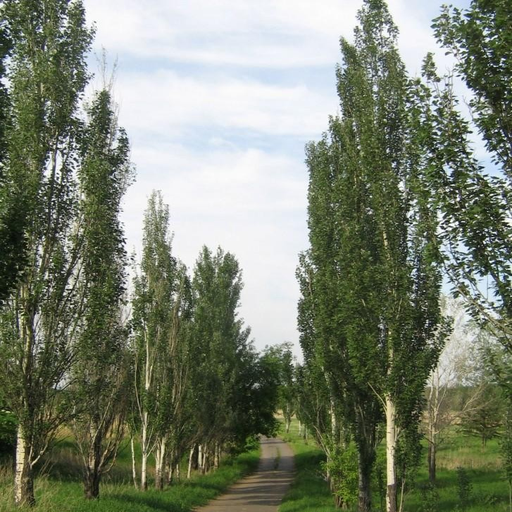
Traditional Science and Botany:
- Poplar belongs to the Salicaceae family and the Populus
- It is widely distributed across Europe, Asia, and North America.
- Common species include:
- Populus nigra — Black poplar
- Populus alba — White poplar
- Populus pyramidalis — Lombardy (Italian) poplar
- A deciduous tree that typically grows 25–35 m tall, with some species reaching up to 40 m.
- Leaves are broad and vary in shape (triangular, heart-shaped, or rounded), often fluttering in the wind.
Characteristics:
- A very fast-growing tree that can grow 2–4 meters per year under favorable conditions.
- Possesses a strong root system that stabilizes soil and helps prevent erosion.
- Absorbs large amounts of CO₂ and produces oxygen, making it an effective air-purifying tree.
- Its broad leaf surface helps capture dust, heavy metals, and harmful gases.
- Adapts well to various climates, though it prefers moist soils.
Uses:
- Urban landscaping and city planning — widely used for greening streets, avenues, and parks.
- Wind protection — planted as windbreaks in agricultural and open-field areas.
- Ecological role — contributes to soil moisture retention and improves the local microclimate.
Relevance for Yerevan and Armenia:
- In Yerevan, poplar is highly suitable for greening streets, industrial zones, and highways to reduce air pollution.
- Provides fast shade, which is especially valuable during hot summer days.